Early Years CPD: Building a Plan Your Team Will Actually Finish
Most nursery CPD plans are a spreadsheet of expired certificates. Here's how to build a twelve-month CPD cycle that raises practice and survives a busy term.
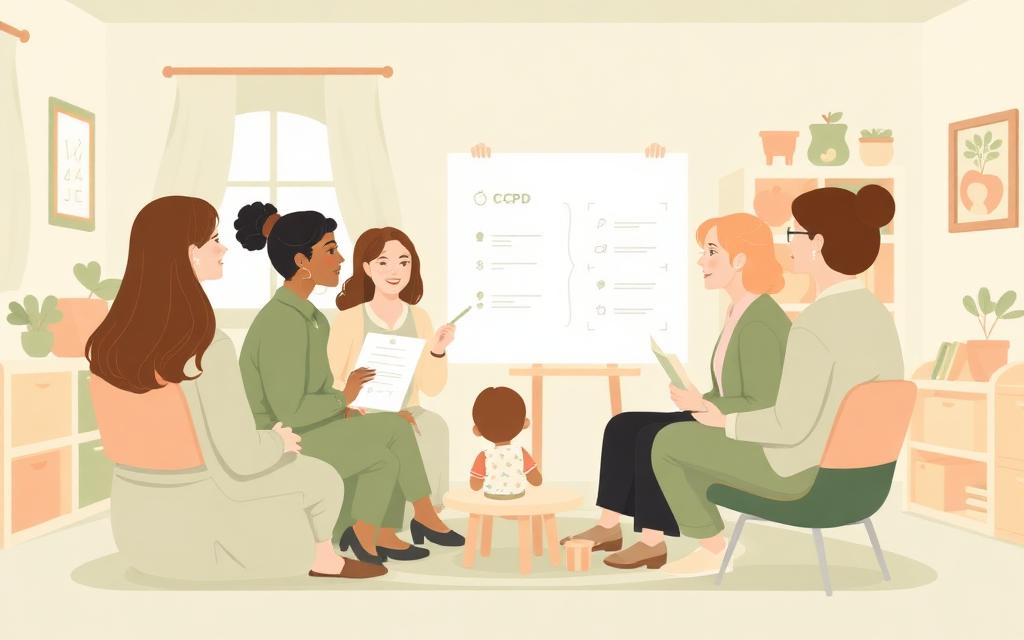
Ask most managers about CPD and you get a spreadsheet: safeguarding, paediatric first aid, food hygiene, all with expiry dates in red. That is compliance training. It is necessary, and it is not CPD.
Continuing professional development is the thing that changes what happens on the carpet at half past nine on a Tuesday. Here is how to build a plan that does that.
Start from a practice question, not a course catalogue
Before you book anything, name the one thing you want to be visibly better in twelve months. Good examples:
- "Our two-year-olds' language is behind and our adults talk over them"
- "Our outdoor provision is a dumping ground, not a learning environment"
- "Our team can't describe what progress looks like for a child with SEND"
A single practice question turns scattered training into a campaign. Everything you book, read, model and discuss for the year points the same direction.
The three-layer CPD model
**Layer 1 — Compliance (non-negotiable, dated).** Safeguarding, first aid, food hygiene, health and safety, Prevent, fire. Track expiry dates 90 days out. This layer keeps you registered.
**Layer 2 — Role capability (annual, per person).** What does a room leader need that an apprentice doesn't? Map three capabilities per role, review them at supervision, and pick one target per person per term.
**Layer 3 — Setting priority (whole-team, one per year).** Your practice question from above. Everyone works on it. This is the layer that moves your Ofsted judgement.
Make the cheap methods do the heavy lifting
External training is the most expensive and least reliable route to changed practice. The methods that actually shift behaviour cost little:
- **Modelling.** You or a strong practitioner working alongside someone for twenty minutes, then a two-minute debrief.
- **Learning walks with one lens.** Walk the setting for fifteen minutes looking only at adult questioning. Nothing else. Feed back the same day.
- **Ten-minute team meeting slots.** One idea, one thing to try this week, one report-back next week.
- **Video of your own practice.** Uncomfortable, transformative, free. Consent and GDPR handled properly.
- **Peer observation pairs.** Two practitioners observing each other monthly against one agreed criterion.
Tie CPD to supervision, or it will not survive the term
Every supervision should end with the same three questions:
- What did you try since we last met?
- What difference did it make for the children?
- What is the one thing you'll work on before we meet again?
Write the answers down. Six supervisions later you have an evidence trail that any inspector will recognise as a culture of improvement — and, more importantly, a practitioner who has genuinely developed.
Budgeting realistically
For a 40-place setting, a workable annual pattern:
- Compliance renewals: budget as a fixed cost, spread across the year
- One paid external course for the setting priority, cascaded to the whole team by the attendee
- Two funded local authority or sector-body sessions
- Free: your own modelling, learning walks, peer observation, sector reading
Cascading is the multiplier. Anyone who attends external training owes the team a fifteen-minute slot and one practical change to try.
The record that proves it
A CPD record that works has, per person: the training, the date, the cost, what changed in practice as a result, and how you know. That last column is the one nearly every setting leaves blank, and the one that makes the difference in an inspection conversation.
Twelve-month rhythm
- **September:** set the setting priority, individual targets at supervision
- **November:** first learning walk against the priority, mid-point check
- **January:** compliance audit, expiry sweep for the year ahead
- **March:** peer observation cycle, cascade session from external training
- **June:** impact review — what changed for children?
- **July:** set next year's practice question from what you found
Early Years Circle members get the CPD Cycle Pack — training matrix, supervision templates, learning walk proformas, peer observation forms and an impact record — plus AI coaching to shape your setting's practice question.
Get the Ofsted Readiness Checklist
The questions inspectors actually ask, room by room. Pop in your email and it's yours — just your email, no payment.
Send me the checklist